
 Princeton University
 Shortwave Radiative Flux Variability Through the Lens of the Pacific Decadal Oscillation
By B. Chtirkova, D. Folini, L. F. Correa and M. Wild
Published in Journal of Geophysical Research: Atmospheres , 2024
https://doi.org/10.1029/2023JD040520
Motivated by the observed correlation between the Pacific Decadal Oscillation (PDO) index and downwelling shortwave radiation trends in Europe and the United States and the dynamical mechanism for it suggested by Augustine and Capotondi (2015), we use the atmospheric component of the Icosahedral Nonhydrostatic Model (ICON-A) with prescribed sea surface temperatures in the North Pacific Ocean corresponding to specific PDO index values. The simulations revealed that such a large scale perturbation in the sea surface temperatures leads to a global redistribution of clouds.
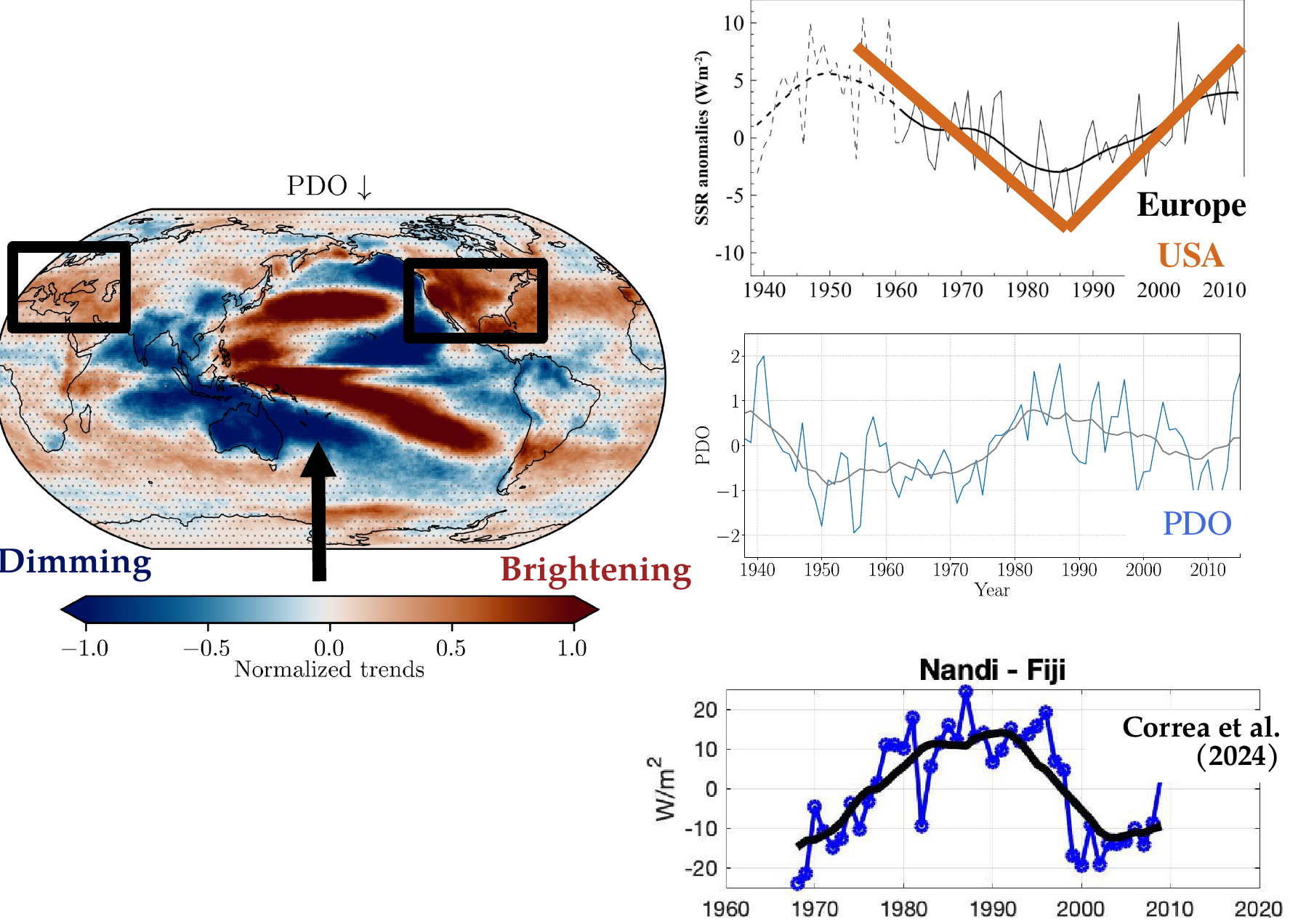
The figure shows time series of the historical evolution of the PDO index and spatially aggregated trends of surface solar radiation in Europe (Sanchez-Lorenzo et al., 2015), United States (Augustine and Capotondi, 2015) and Nandi, Fiji (Correa et al., 2024). The direction of trends (positive versus negative) relative to the PDO index corresponds with the prediction from the idealized simulations.
A further investigation on the role of radiative anomalies in shaping and sustaining climate modes of variability is needed - e.g. the surface brightening in the warm sector and surface dimming in the cold sector of the sea surface temperature anomalies.