
 Princeton University
 Internal Variability of All-Sky and Clear-Sky Surface Solar Radiation on Decadal Timescales
By B. Chtirkova, D. Folini, L. F. Correa and M. Wild
Published in Journal of Geophysical Research: Atmospheres , 2022
https://doi.org/10.1029/2021JD036332
We set off to gain a better understanding over the range of influence of internal variability over decadal-scale trends of surface solar radiation, a key energy budget variable. We performed a statistical analysis on unforced multi-century Coupled models intercomparison project – Phase 6 simulations (piControl), which do not include any natural (e.g., volcanoes) or anthropogenic (e.g., greenhouse gases and aerosols) forcing. We show that for surface solar radiation the distribution of all possible N-year trends can be analytically derived from the standard deviation of the underlying time series (σts). This results from two important properties of the time series: that the distribution of all values is Gaussian and that there is no autocorrelation in time. Based on our analysis, we can estimate the probability of an unforced trend (or unforced component contributing to a trend) for different spots on the planet.
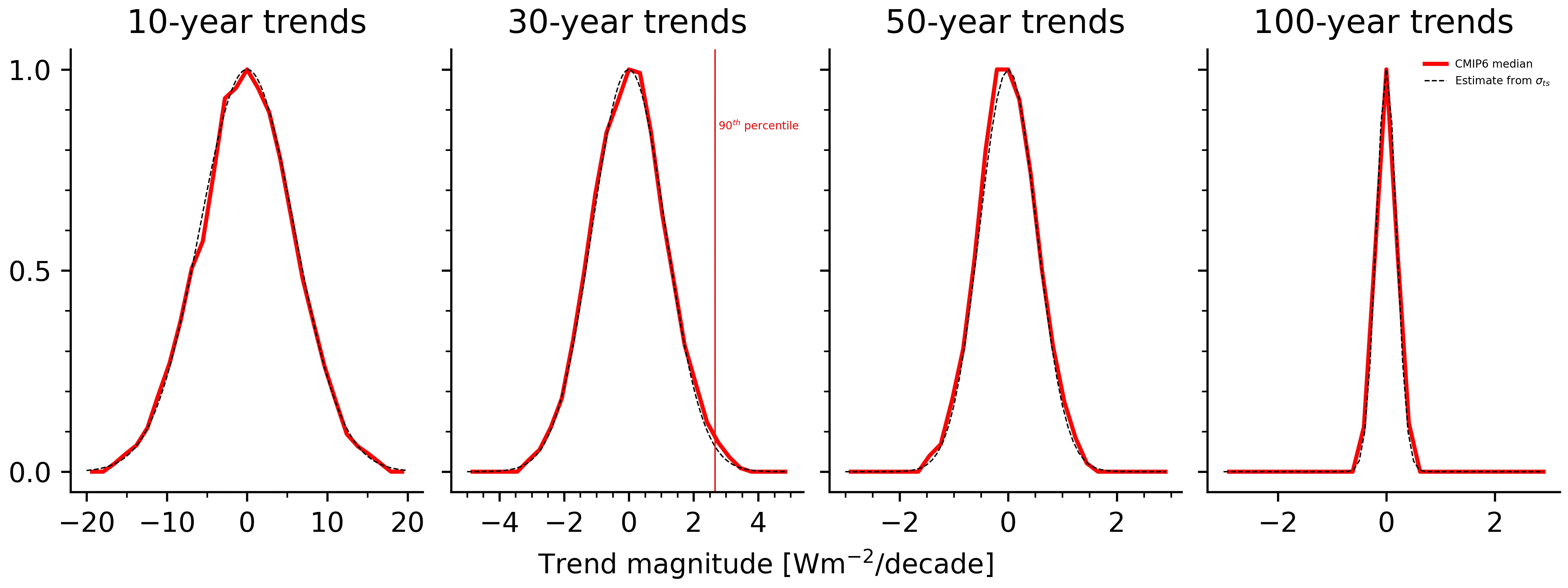
The figure shows the trends distribution over different N-year periods for Lindenberg, Germany. At this location, an unforced trend with a magnitude of 2.7 Wm-2/decade can be sustained over 30-years with a probability of 10% (90th percentile of the 30-year trends distribution). The magnitude of unforced trends decreases over longer time scales.